About Sylvie Cowell — Fractional EOS Integrator — Cowell & Co Skip to content
Cowell & Co
Book a Conversation

About Sylvie Cowell

I have spent my career in the seat where strategy has to become execution.

Not advising on it from outside. Carrying responsibility for the result.

A standard I was held to before I could hold it myself.

I left France at seventeen, on my own, and enrolled myself in a school in England. I had a host family and not much else. That is more or less how I have made every significant decision since: work out what I need, go, then organise everything around it.

Ten of the years that followed were spent at Expression for Growth, a consultancy in Hampshire training organisations in selling, negotiation, strategic planning and facilitation. It changed my life, and not gently. I was trained, pushed and mentored to a standard I had not known I could reach. I remember watching a recording of my own presentation with my coaches and being told, plainly, that it was not good enough and they could not put me in front of a client yet.

I did not want reassurance. I wanted to be better. So I got better.

What they gave me was not a technique. It was a standard, and the experience of being developed by people who could see something in me before I could see it myself.

That is why one of my values is Seen. Accompanied. Freed.

Seen. Recognised for what you are truly capable of, before you can see it yourself. Accompanied. Walked alongside. Not directed, not carried. Freed. Left with the capability, the confidence and the structure to no longer need me.

This is how I was developed. It is what I commit to for others.
Being accountable for the result is a different job from advising on it.

I moved from teaching businesses how to work to being answerable for whether they did. As Head of Operations in a £700,000 consultancy I restructured the business, built the accountability structures it had never had, and removed unnecessary costs equal to 7% of turnover within five months.

That is the experience founders are actually buying. Not a framework I have read about. A decade of sitting in the seat where the plan meets the week, and knowing what happens in that gap.

I did not plan this business. I was pushed into it, and it turned out to be exactly right.

In 2025 I was made redundant. The business I worked for was liquidated.

Three days later I posted on LinkedIn saying I was looking for what came next. A couple of days after that, someone in my network recommended me to a founder who needed precisely what I do. I had a client.

I had a client before I had decided to build a business. That is the honest order of events. I did not write a plan and go looking for people to serve. Somebody needed the work done, I did it, and then I worked out what the business was.

I would not have chosen the redundancy. I do not regret it either. Every decision I have made, good and bad, got me here.

I take the Integrator seat, on fractional terms.

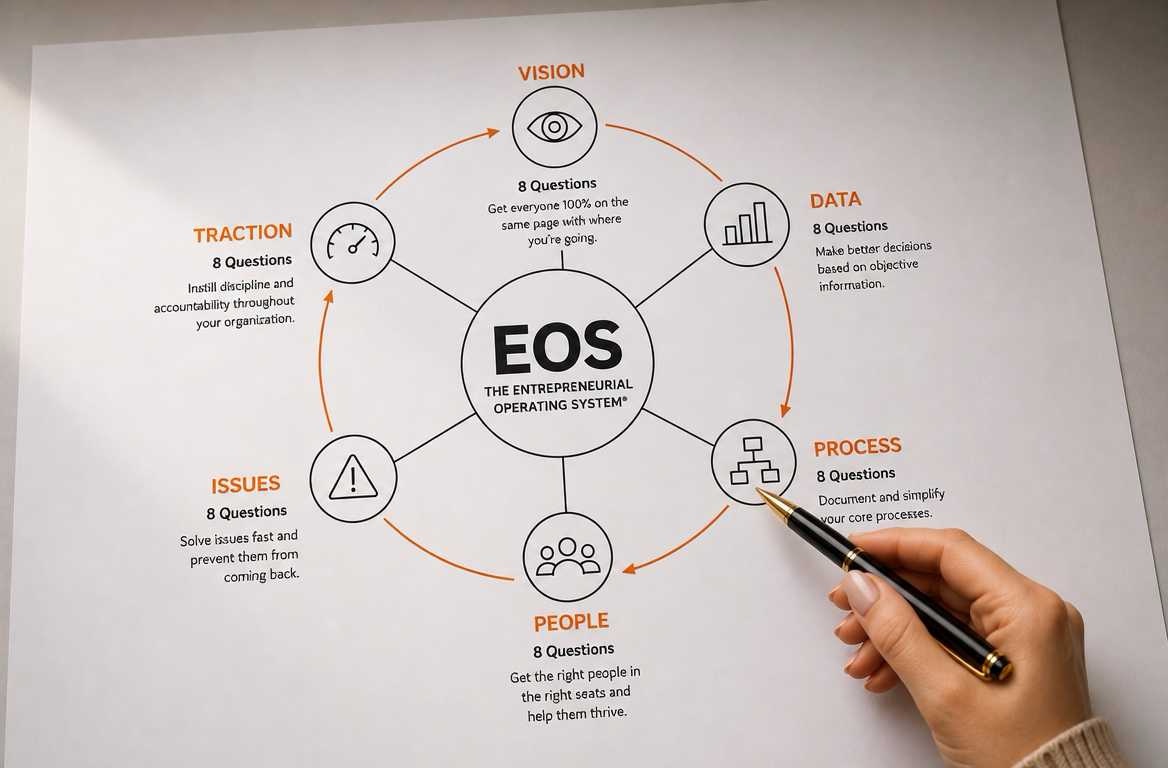
In the EOS model, the Integrator is the person who sits alongside the founder and turns a vision into owned priorities, clear accountability and an operating rhythm that holds when the pressure comes.

Founders are usually visionaries. Most are not wired to manage, and there is no reason they should be. I am. I bring the structure, the discipline, the focus and the cadence, so the founder can do the one job only they can do.

I am in the room. I run the meetings, track the numbers, hold people to what was agreed, and chase the things that would otherwise quietly drift. Between sessions I am not dormant. Chasing is not an inconvenience of the role. It is the role.

A very good framework, with gaps I am open about.

I have used EOS for around ten years and I think it is genuinely good. I also think it is incomplete.

It gives you strong architecture: how the business is structured, how decisions get made, how priorities are held through time. What it does not give you is depth inside each function. Marketing, sales and finance are barely touched.

My view is that the Integrator should not be the person with all the answers. The Integrator should be the person who brings the right expertise in. That is why I co-founded Fractionals UK, a network of fractional leaders who are properly expert in their own fields. When a client's finance function needs work, the right answer is a finance specialist, not me improvising.

I should also be clear about what I am not. I am not a licensed EOS Implementer and I do not teach the methodology from the front of a room. I apply EOS principles, as purely or as loosely as the business needs, from inside the business.

Fit matters more than enthusiasm.

I work with founder-led businesses of roughly eight to thirty people, typically turning over between half a million and five million pounds, in professional and knowledge-based sectors. Mortgage brokerages, technology businesses, advisory firms, agencies.

The founders I can help have recognised the business is no longer moving forward. They want to change something. They are prepared to be challenged on what they have always done.

I am not the right person for a founder who wants the work taken off their desk. I expect commitment. You need to dedicate real time to working on your business, with my support rather than in place of it. If you are expecting me to do the job for you, you have the wrong person, and you would be the wrong client for me.

One more thing worth saying in advance. Somewhere in most engagements there is a conversation about leadership, and it is usually about the founder's own. It is rarely the first conversation we have. It is almost always a necessary one.

I take on around seven retainer clients a year. Working properly inside a business takes real time and attention, so growth for me means being selective, not taking on more.

Four values. Each one deliberate.

Intentionality.

Everything I do has a reason behind it and a desired outcome ahead of it. I do not let habit, convenience or comfort make decisions. If I cannot connect an action to an outcome, I stop doing it. The most expensive thing in any business is the thing nobody questions.

Curiosity.

I ask before I conclude. I listen before I diagnose. Curiosity, for me, is not a personality trait. It is a commitment to not assuming I already know. I validate rather than judge, and I ask questions that let people see things for themselves, because a realisation you reach yourself is worth more than an answer someone gives you.

Seen. Accompanied. Freed.

People grow best when they are seen, accompanied, and then freed. This is how I was developed. It is what I commit to for others.

Deliver Better Together.

With the right people, the right behaviours, the right systems and the right processes, we can deliver anything better together than any one of us could alone. I do not believe in the hero model of leadership. Together is not a nice sentiment. It is a deliberate choice, and it takes work to make it real.

In 2026 Cowell & Co was named Operating System Integrator of the Year at the SME News UK Enterprise Awards and Business Consultancy of the Year by The Business Awards UK.

Fractional operational leadership is still an emerging category. Founders have no shortage of coaches, consultants and advisors to choose from. What is harder to find is someone who will step into the business, take genuine accountability for the operational result, and stay until the change can sustain itself.

The stronger evidence is what changed inside client businesses.

See the results

Does any of this sound like your business?

The first conversation is 45 minutes. No preparation, no pitch, and no obligation to take it further. You will get an honest view of whether what is holding you back is structural, and a clear sense of the most sensible next step, even if that step is not me.

Book a conversation

Or, if you would rather start privately, the three-minute Operating System Diagnosis will show you where the gaps are.